AI Risk Appetite Frameworks for Enterprise Security Leaders
Build risk frameworks around how AI actually behaves, not how legacy controls assumed it would.

Enterprise security teams built their governance muscle on frameworks that assume a machine does what it was told, every time. NIST CSF, ISO 27001, COBIT: all of them assume identifiable assets, predictable behavior, and a human somewhere making the actual call. AI breaks that assumption in at least three ways, and the gap it leaves behind is already showing up as a line item on breach reports. Most enterprise AI governance programs fail for a simple, boring reason: they treat risk appetite as a document to publish instead of a threshold to enforce. A document doesn't stop a compromised agent from doing anything.
AI outputs are probabilistic. The same prompt can return two different answers depending on context, temperature settings, or what the model happened to retrieve that session. Agents don't just process what's handed to them, either; they initiate action on their own, calling tools, writing to databases, sending emails, without waiting for a human to click approve. And the risk profile of a given model doesn't hold still. A model that cleared last quarter's audit can behave differently today, because it got fine-tuned, or it started encountering prompts nobody tested for, or someone connected it to a new tool that changed what it's capable of doing.
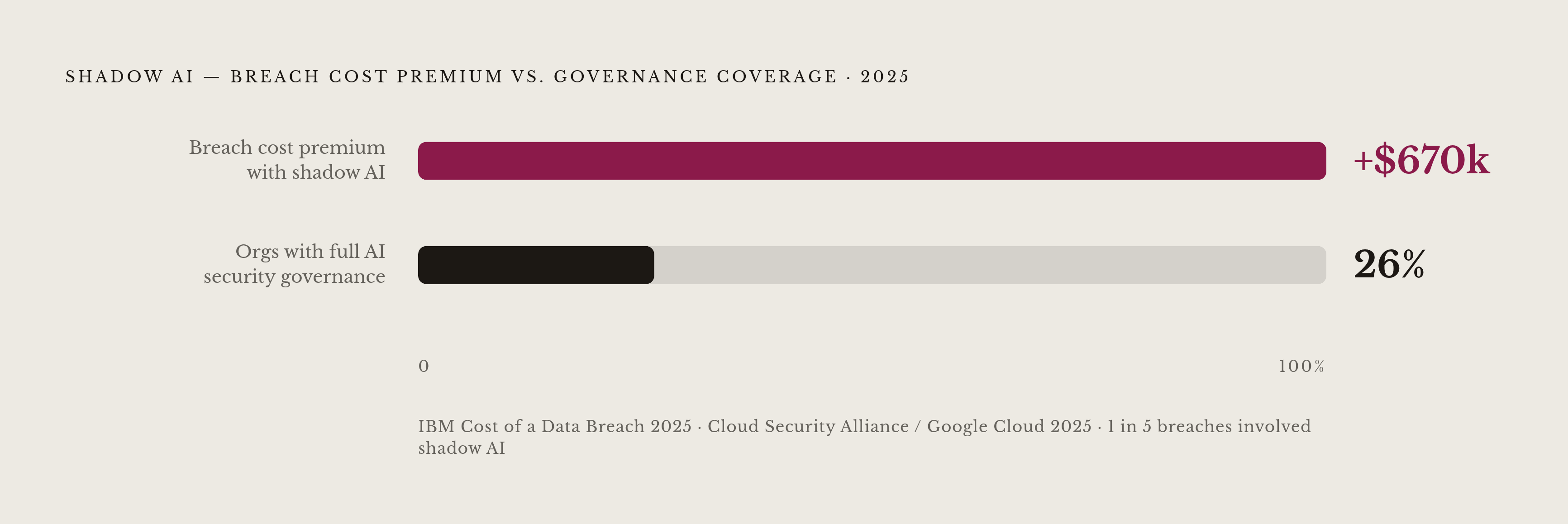
That gap between what the old controls assume and what AI actually does isn't theoretical. IBM's Cost of a Data Breach Report 2025 found that one in five organizations had a breach involving shadow AI, and those organizations paid roughly $670,000 more per breach than peers with little or no shadow AI in the mix. A 2025 survey by the Cloud Security Alliance and Google Cloud found that only 26% of companies have anything resembling full AI security governance in place. Most of the enterprise world is governing a fundamentally new class of technology with a rulebook written for the old one, and no amount of policy language fixes that. What's needed is a framework built around the fact that AI moves, acts, and changes shape faster than a firewall was ever designed to track.
Risk appetite is the board-endorsed answer to a blunt question: how much AI-related risk is the organization willing to eat in pursuit of what it's trying to do? A policy says what's banned and what's required. Risk appetite says how much risk is still sitting there after the controls are applied, and whether that residual amount is acceptable. It works less like a fence and more like a dial, and most organizations reach for the fence anyway, because a dial requires someone to pick a number and defend it in front of a board.
Risk tolerance is the related but distinct concept sitting just underneath it: the acceptable wobble around the appetite line, the band within which a team can operate without triggering an escalation. Appetite is the speed limit. Tolerance is how many miles over it a cop will actually pull you over for.
This distinction matters more for AI than it ever did for a firewall rule, because the same model can carry wildly different risk depending on what it's plugged into. An LLM summarizing internal meeting notes is low stakes. The same model wired into an automated contract-approval pipeline is a different animal, and a framework that doesn't encode that difference is worthless on arrival. Skip the explicit appetite statement, and security teams end up doing one of two things: blocking everything, which kills adoption and sends users straight into shadow AI, or approving everything, which just makes the risk invisible instead of managed. Blocking is the more common mistake, and the more expensive one, because it doesn't eliminate risk. It just moves the risk somewhere the security team can't see it anymore.
Governance observers have noted this failure mode repeatedly: without people from different functions actually at the table, AI governance collapses into a pattern of writing down responsible-AI principles and never implementing a single one of them. A risk appetite framework is the thing that keeps that from happening, because it forces someone to make an explicit choice about how much risk is acceptable, rather than let an aspirational memo stand in for a decision nobody actually made.
The accountability structure that has to exist before any thresholds can be set
The Chief Risk Officer already owns the enterprise-wide risk appetite framework that every other function operates inside. AI risk appetite needs to live inside that same structure, not bolted onto the side as some parallel governance track that only the security team ever reads.
Siloed accountability is the failure mode to watch for, and it plays out the same way almost everywhere. The CISO treats AI as an infrastructure security problem. The CDO treats it as a data quality problem. The CRO treats it as one more box on a compliance checklist. None of them sees the whole picture, and that's exactly how a model clears security review, satisfies the compliance checklist, and still ships outputs that are biased, harmful, or reputationally catastrophic enough to land in a headline. Three functions signed off. Nobody owned the outcome.
The Chief AI Officer role exists precisely to close that gap: to sit across governance, strategy, risk, and the push to actually use the technology, working alongside the CISO, CDO, and CRO rather than replacing any of them. Below that role, the framework needs to name names, not job descriptions. Who owns the policy that governs how AI gets used. Who's responsible when a specific model in production starts behaving badly. Who has the authority to sign off on a deployment decision, and at what threshold does that authority escalate up the chain.
NIST's AI Risk Management Framework gives this structure its anchor point, in the function it calls Govern: explicit ownership of risk, tied all the way up to senior leadership, with recommended reporting lines into the board or a governance council. Not a checklist of controls that got implemented somewhere, but a person whose name is attached to the outcome. ISO 42001 pushes the idea further, tying accountability to what actually happens once a model is live. Skip this step, and any threshold the organization sets is advisory at best. Calibration only means something once somebody is on the hook for staying inside it.
How to classify AI use cases by risk tier before setting thresholds
Risk classification is about how a model is used. The same LLM answering internal search queries and the same LLM executing contracts autonomously carry entirely different risk profiles, even though the underlying weights are identical. Companies that classify by model instead of by use case end up applying the same guardrails to a chatbot and to an autonomous approval engine. Which means the guardrails are wrong for both of them at once, a neat trick if the goal were failure.
A working classification system needs to capture five things at minimum. How much autonomy does the system have: does it recommend an action, assist with one, or just go do it. What kind of data does it touch, and how sensitive is that data. Is a wrong output reversible, or does the damage happen before anyone notices. Is there an actual human standing at the point where a consequential decision gets made, or is that a formality nobody checks. And does the use case land inside a regulated industry, touch regulated data, or fall into a high-risk category under something like the EU AI Act.
The EU AI Act already hands enterprises a ready-made tier structure: unacceptable risk, high-risk, limited-risk, and minimal-risk. Any organization operating in or brushing up against EU markets has to map its internal tiers to that structure anyway, so it's a reasonable starting template even outside that jurisdiction. NIST's AI RMF supplies the operational half of the job through its Map function: identify the context of use, figure out who's affected, estimate the likelihood and size of the harm, before a single control gets designed.
FATE, the shorthand for fairness, accountability, transparency, and explainability, belongs baked into that same review, not treated as a separate audit tacked on later. The output of all this work is concrete, taking the form of a tiered inventory of every AI use case in the building, with a risk level, a named owner, and a defined set of controls attached to each tier. That inventory is what the thresholds in the next section get applied to.
One wrinkle worth flagging: this inventory goes stale fast. The rapid pace of agentic AI deployment means the classification work described here isn't a project with an end date, it's a discovery mechanism that has to run continuously, or the inventory is out of date before the ink dries.
Calibrating specific thresholds for AI-specific risk categories
A threshold only earns its keep if someone can measure a breach of it. Each category below needs to turn into a number or a condition a security team can actually monitor, not a paragraph of good intentions.
Shadow AI. Employees are already using AI tools whether the security team approved them or not, and Deloitte's 2026 State of AI in the Enterprise report found employee access to AI roughly doubled through 2025. The threshold that matters is the ratio of sanctioned to detected-but-unsanctioned tool usage, paired with a detection latency figure: how many days pass before an unapproved tool gets flagged and reviewed. Banning everything outright isn't a strategy, it's a way of pushing usage further underground and making detection harder, which enterprises that have tried blanket prohibitions have repeatedly found to be true. The better move is a tiered appetite statement that separates tolerated-pending-review from flatly prohibited, each with its own review clock attached.
Prompt injection. This appears prominently in the OWASP Top 10 for LLM Applications 2025, and Anthropic's own system card data shows attack success rates climbing sharply the more times an attacker gets to try against a coding environment. The EchoLeak attack, disclosed by Aim Security in mid-2025, is the case worth knowing: a zero-click exploit against Microsoft 365 Copilot where the victim never touched the malicious payload. Perimeter defenses did nothing, because the attack lived in the semantic layer, not the network layer. The threshold logic here needs two numbers: maximum tolerated time to detect an active injection attempt, and a clear line between which agent capabilities get suspended automatically on detection versus which need a human to sign off. Add one hard rule on top: no API keys, credentials, connection strings, or access rules ever get stored inside a system prompt. OWASP tracks this separately as System Prompt Leakage, LLM07:2025, and it deserves its own audit line, not a footnote under injection.
Agent identity and privilege. Okta's AI Agents at Work 2026 report found that only a minority of organizations apply the same security controls to AI agents that they apply to human employees, which means most agents are racking up access with no governed identity behind them at all. Security researchers have documented cases where gaps in agent identity governance became the doorway for a full ransomware chain. The failure wasn't the model. It was the missing identity layer underneath it, a gap nobody thought to patch because agents weren't supposed to need one. The threshold here needs to cap the maximum permission scope any class of agent can hold without human sign-off, set a review cycle for rotating agent credentials, and tie agent identity into existing identity providers, Okta's Agent SSO or Entra ID, so agents inherit the same role-based access rules a human employee would.
Data leakage via AI tools. Research into enterprise AI usage patterns has consistently found that a large share of the data employees hand over to AI tools qualifies as sensitive, and much of it flows into platforms carrying elevated risk classifications. Across reported analyses, the categories most commonly identified as leaking include source code, legal documents, and financial projections. The threshold work here is naming which data categories are flatly prohibited from ever touching an AI tool without a DLP control in front of them, and setting a hard ceiling on how many sensitive tokens can pass through a single session before an alert fires or the session gets blocked outright.
Integrating AI risk thresholds with the MCP and agentic tool layer
Agents don't just talk to models. They talk to enterprise systems through MCP servers, and traffic through that channel has grown fast across major platforms in the last few quarters. That's a parallel access channel running at real volume, and most existing security stacks were built without the ability to see it, let alone control it. Treating MCP as an afterthought to the model layer is the mistake to avoid here, because the model is rarely what gets exploited. The plumbing underneath it is.
The attack surface isn't hypothetical. The first malicious MCP package showed up in September 2025 and sat undetected for an extended period while it quietly pulled email data out the door. In March 2026, a backdoor landed on PyPI inside a package called LiteLLM, which happens to serve as the language-model gateway for CrewAI, DSPy, Microsoft GraphRAG, and a long list of other agent frameworks. It sat live for a short window before being pulled. In that window it racked up a large number of downloads. Separately, academic research analyzing nearly 1,900 open-source MCP servers found that a measurable share of them carried tool-poisoning vulnerabilities specific to the MCP protocol itself, not to any model sitting behind it.
Credential aggregation is the sharpest edge of this problem, an issue most teams haven't priced in yet. MCP servers hold OAuth tokens for multiple downstream services at once, so one compromised server hands an attacker the keys to everything it's connected to, not just the one system anyone was worried about. The risk appetite framework needs a hard cap on how much credential scope any single MCP server is allowed to aggregate. OAuth 2.1, introduced in the MCP specification's March 2025 revision and tightened further in the June 2025 update that reclassified MCP servers as OAuth Resource Servers, is the baseline every enterprise should be testing against, specifically the on-behalf-of identity flow, since implementations of it vary a lot in quality from vendor to vendor.
The fix Gartner points to in its emerging practices guidance is treating MCP the way any mature security team already treats an API surface: put a gateway in front of it. A real MCP gateway centralizes authentication, authorization, audit logging, and traffic control into one place, which is what makes the thresholds above enforceable instead of aspirational. Skip the gateway, and every agent ends up carrying its own scattered credentials across environment variables, config files, and secret stores. At that point a credential-scope threshold is a number in a document, unenforceable the moment anyone actually tests it.
A handful of vendors have already built for this specific gap. TrueFoundry earned a spot as a Representative Vendor in Gartner's 2025 Market Guide for AI Gateways. Lasso Security focuses on real-time injection detection. Composio runs tools inside sandboxed environments. Airlock handles human-in-the-loop approval, per-user authentication, and budget controls for agent spend. Nutanix shipped its own Agent Gateway as part of Nutanix Enterprise AI 2.7. None of these tools replaces the threshold decisions above. But without one of them sitting in front of the MCP layer, those decisions have nowhere to actually run.
Operationalizing the framework: from thresholds on paper to enforced policy
A threshold that lives in a slide deck protects nobody. Adaptive Security's enterprise AI governance guide, echoing the structure NIST's AI RMF lays out, starts the implementation sequence in the same place every time: assess first. That means finding and inventorying every AI system, every agent, and every tool actually in use across the organization, not just the ones that got formally approved through procurement.
That inventory is the foundation everything else sits on, and it's also the piece most organizations skip, because it's slow, unglamorous, and it turns up things nobody wants to find, like a marketing team's unsanctioned copy of a chatbot plugged straight into the CRM. Skip that step, though, and the thresholds calibrated above are just numbers with nothing underneath them: a speed limit posted on a road nobody's bothered to map.