AI Risk Reporting Frameworks for Board Audit Committees
Boards need documented AI governance now, before regulators and auditors start asking for proof.

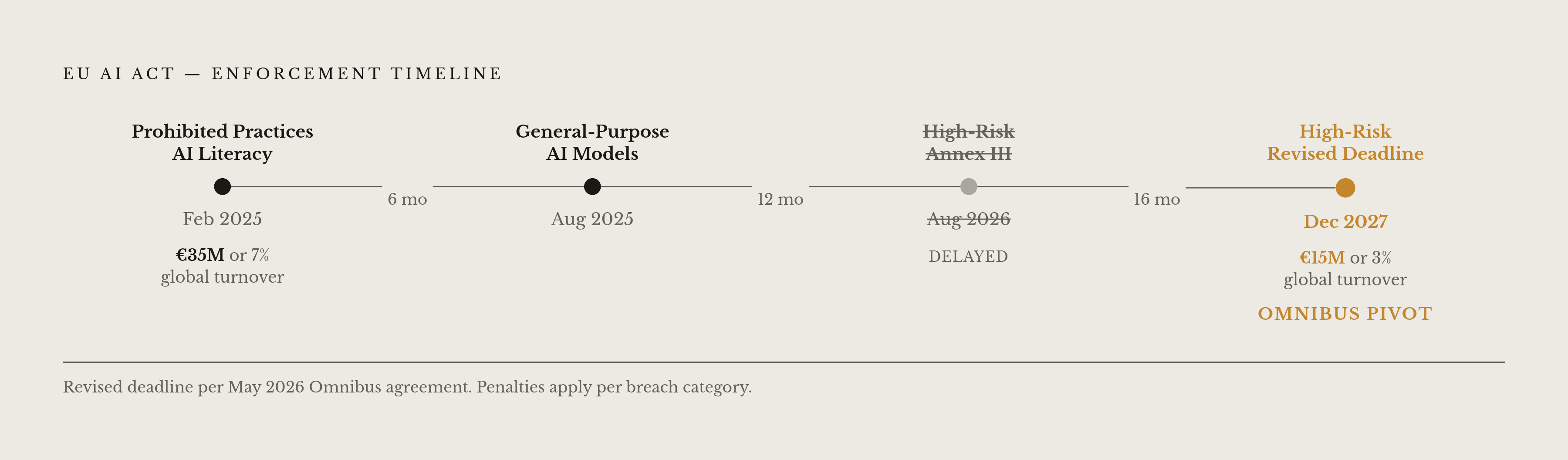
One regional AI law gives the clearest timeline, and it's worth memorizing if any part of the business touches operations or customers there. Prohibited practices and AI literacy obligations have been enforceable since February 2025. General-purpose AI model rules kicked in that August. High-risk obligations under Annex III were originally due in August 2026, but a May 2026 Omnibus agreement pushed that to December 2027. Plan as though the extension holds, but build as though it might not, because the fines aren't abstract: prohibited practices carry penalties up to 35 million euros or 7% of global turnover, and high-risk breaches run up to 15 million euros or 3%. Those numbers end up quoted in shareholder letters, not footnotes.
The SEC hasn't issued a final AI rule as of mid-2026, but AI-related risk disclosure already belongs in the Description of Business, Risk Factors, and MD&A sections of a 10-K, and companies have gotten the memo. The regulator meant to referee audit standards for AI, meanwhile, is behind its own schedule: the PCAOB's Technology Innovation Alliance Working Group finished a Future State Deliverable in May 2024 and sat on it until August 2025, and none of its four strategic pillars have become binding standards as of mid-2026.
Add Colorado's high-risk AI and algorithmic discrimination law taking effect in 2026, plus dozens of countries with AI legislation adopted or drafted, and the patchwork itself becomes the compliance risk. Tracking which rule applies where is a full-time job now, not a side project for whoever drew the short straw in legal. Proxy advisers have noticed the gap between informal AI chatter at the board level and documented oversight, and they're increasingly focused on it. That's not a warning shot. That's a scheduling problem, and the calendar is already full.
The four questions every audit committee is now asking, and why most compliance teams cannot answer them
Strip away the framework names, and the guidance from NACD and NIST comes down to four questions. Is there a documented framework? Is someone accountable? Is compliance monitored continuously? Are incidents reported and resolved?
Directors don't need to know how a transformer model works. They need proof, and proof is exactly what most compliance programs can't produce on demand, because nobody built the evidence trail into the deployment process to begin with. What exists instead is a policy PDF nobody's opened since it was drafted, a pile of engineering tickets nobody indexed, and a vendor's word that its safety framework is sound. None of it is stitched into a record an external auditor can pick up and read without weeks of reconstruction. That reconstruction cost is the real hidden expense of "informal" AI governance. It never shows up on a budget line. It shows up as three weeks of someone's Q3, disappeared.
Accountability turns out to be the biggest lever by a wide margin. Research on AI maturity has found organizations with explicit, named accountability for responsible AI scored 44% higher on governance maturity measures than those without it. That's not a soft finding about culture. It's the gap between a company that hands an auditor a name and an org chart, and one that hands over a shrug.
KPMG's guidance for boards distills the same four questions into practical prompts: does the board have the digital fluency to govern AI at all, is there a framework, is the workforce trained on it, and how does the company assess third-party AI risk as new vendors come on board. That last one deserves attention on its own, because audit committees are increasingly refusing to take vendor assurances at face value, the same way they now ask external auditors to explain AI-assisted audit work instead of accepting it as a black box. A clause buried in a vendor's safety documentation is not a control, no matter how official the PDF looks.
Staffing has grown, but not fast enough to close the gap. Available data show AI governance job postings jumped in 2025, yet the same research flags persistent, unresolved weaknesses in model audit and bias mitigation. Headcount is rising faster than depth, which is a bit like hiring more lifeguards without checking whether any of them can swim.
Shadow AI as the audit committee's most immediate blind spot
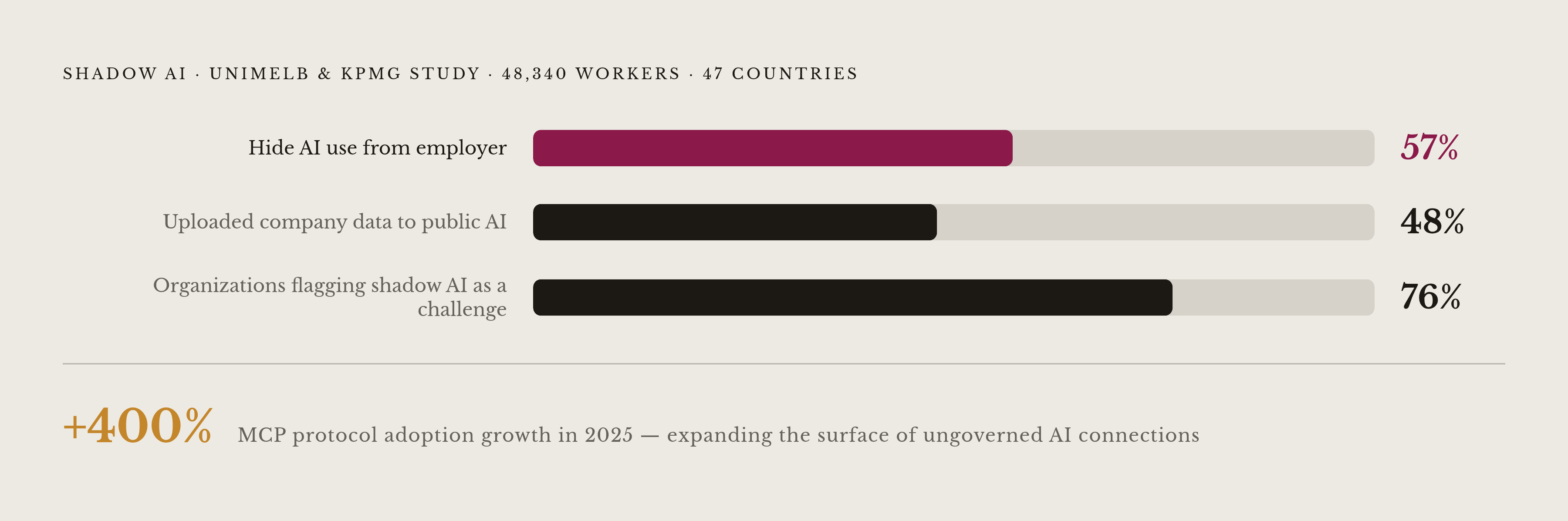
Here's the number that should make any audit committee sit up straight: in the largest global study of workplace AI use to date, covering 48,340 workers across 47 countries (University of Melbourne and KPMG), 57% of employees admitted hiding their AI use from their employer, and 48% had uploaded company data to a public AI tool. Most AI activity inside a typical company is, by definition, invisible to the people responsible for governing it. That's not a gap in the policy. That's a policy that never had eyes on the thing it claims to govern.
Shadow AI is a problem already confronting companies now. It's already 76% of organizations calling it a definite or probable challenge, up sharply from the year before. And it carries a price tag: Research into data breach costs has found that shadow AI incidents add significantly to the average breach cost. That exposure belongs in a board deck, not buried in a security team's messaging channel, because it's exactly the kind of financial risk an audit committee exists to track.
The accelerant is a protocol most directors have never heard of. Model Context Protocol, or MCP, lets AI agents connect to internal systems, query databases, and trigger actions on their own. Adoption grew more than 400% in 2025, and most of those deployments skipped a formal security review entirely. Think of it as the successor to unauthorized SaaS signups from a decade ago, except this version doesn't just store a spreadsheet somewhere unsanctioned. It can reach into a production database and pull a lever.
Reliability adds a second layer of exposure. Surveys consistently find that substantial shares of employees report seeing inaccurate or biased AI output and worry specifically about hallucinations. When that output touches anything near accounting or financial reporting, a hallucination stops being a UX complaint and becomes a control failure.
Banning unsanctioned AI tools outright sounds decisive and is the wrong move. A decade ago, banning portable storage devices never actually stopped anyone from using them, it just pushed the behavior further out of sight, and the same logic applies here. The fix is disclosure paired with governed distribution: the committee's job is to demand evidence that a control layer actually exists, not accept a memo saying one should.
The evidence architecture that makes AI risk reports audit-ready
Evidence has to exist before the board meeting starts, not get assembled the week of. That single principle separates programs that survive audit scrutiny from ones that produce a nice-looking slide and nothing behind it.
The building block is an AI Bill of Materials, or AIBOM: a structured inventory of every component in a production AI system, covering models, training data, software dependencies, and hardware. It gets exported in a machine-readable format (CycloneDX is one widely used format for this purpose), and it answers the question an auditor asks first: which AI systems are actually in production, under what policy, and who owns each one. Without an AIBOM, any claim a company makes about its AI controls is unverifiable, full stop, because the board has no way to confirm the scope of what it's even being told about.
Boards are increasingly asking for a specific package on top of that inventory. It needs a usage overview showing total AI systems in production and what changed since last quarter, performance indicators tracking model accuracy and remediation progress, a running list of open compliance issues mapped by jurisdiction and vendor, and an exportable asset inventory an external auditor can take away without asking the internal team to rebuild it first.
Audit logs matter just as much as the inventory itself, and there's a subtlety worth flagging: logs need to come out of the organization's own infrastructure, not get pulled after the fact from a vendor's dashboard. A log generated internally is a governance record. A log reconstructed from a vendor portal after someone asks for it is a story about a governance record, and auditors can tell the difference every time.
Three frameworks do most of the heavy lifting here. NIST's AI Risk Management Framework supplies the risk taxonomy and mitigation playbook. ISO/IEC 42001:2023 sets requirements for an AI Management System at the organizational level rather than the model level, meaning it governs how AI gets deployed and reviewed company-wide instead of certifying individual models. The Databricks AI Governance Framework breaks the work into five pillars and specific considerations, giving teams something closer to a checklist than a philosophy.
On cadence, leading governance guidance points the same direction: align AI risk reporting to whatever schedule the risk committee already runs on, and layer in ad hoc updates for major incidents, significant new deployments, or regulatory shifts that land outside the normal calendar. Governance infrastructure is moving toward policy-as-code, automated and continuous rather than a point-in-time check-the-box exercise. Automating compliance monitoring raises its own transparency questions that regulators haven't settled, so treat that shift as underway, not finished.
How to structure the reporting across the four dimensions audit committees now oversee
System inventory and change tracking. What's in production, what changed since last quarter, what's still in development. This has to cover AI built in-house and AI that arrived quietly through a vendor's product upgrade, a gap KPMG specifically calls out as one companies overlook constantly. KPMG also identifies the two enforcement mechanisms that actually work here: employee attestations and device-level technical controls that restrict access to approved tools only. With enterprise MCP adoption having grown dramatically in 2025, an unregistered MCP connection is probably the single most likely source of an inventory gap in any given company.
Access control and identity governance. Who can use which tool, under what permission level, tied to which verified identity. Role-based access control tied into existing enterprise identity providers, think Okta, Entra ID, SAML or OIDC setups already in place, is the only approach that scales past a few hundred employees. A more recent extension to the MCP specification for enterprise-managed authorization lets the enterprise identity provider become the sole authority granting access to MCP servers, so a user authenticates once through infrastructure the company already controls rather than juggling separate logins per tool. Committees overseeing any agentic deployment should confirm this architecture is actually in place, not assumed. OAuth 2.1 has been incorporated into the MCP spec as the authentication standard, and it's a fair, direct question to put to management: does the deployment comply with it or not. Agentic access deserves the same scrutiny as human access, since an agent acting on a user's behalf needs bounded, auditable permissions, not an inherited blank check.
Real-time threat detection and incident reporting. Detection for PII and secrets leaking into public AI tools has to sit at the AI layer itself, not get bolted on afterward, especially given that nearly half of employees have already uploaded company data to a public AI tool, according to the University of Melbourne and KPMG study cited earlier. Prompt injection deserves a plain-English explanation for the board: an attacker who controls what goes into an AI system can redirect what it does, pull data out, or trigger actions nobody authorized. The question for the committee is whether a policy exists in practice, not just on paper. It's whether detection actually runs, right now, on live traffic. Incident reporting needs three things defined and evidenced rather than assumed: what counts as a reportable AI incident, what the escalation path looks like, and how resolution gets documented. Model reliability failures touching financial reporting or regulated decisions belong in that incident log, not buried in an engineering backlog where nobody outside the team will ever see them.
Cost, usage, and observability telemetry. AI spend deserves the same financial visibility as any other material operating expense. Without usage and cost telemetry, there's no basis for a materiality assessment at all. Usage data across the organization also surfaces shadow AI patterns no policy memo will ever catch on its own, since a sudden spike in traffic to an unsanctioned tool is an incident, not a footnote. The committee should ask management to demonstrate that observability infrastructure exists, not just assert it in a slide. On ownership, ambiguity is the enemy. In most organizations, responsibility sits somewhere between the CIO, the CISO, and a Head of AI or Operations, and given the 44-point maturity gap McKinsey found between explicit and implicit accountability, "somewhere between" is not an acceptable answer to give a regulator.
Translating technical controls into the business-risk language directors and regulators use
Directors don't need a lecture on model architecture. They need to understand three things: exposure, accountability, and remediation status. Every piece of technical evidence above should map back to one of those three, not sit filed under a technical category nobody on the board has the background to parse.
Run it through the four questions one more time, because this is the mapping that actually gets used in the room. "Is there a documented framework?" points to the AIBOM, the chosen governance framework (NIST, ISO 42001, or an equivalent), and the policies that reference both by name. "Is someone accountable?" means naming the actual role and the actual person, showing the escalation path on paper, and citing the McKinsey maturity figure if the committee wants a benchmark to measure against. "Is compliance monitored continuously?" gets answered with the audit log architecture and the cadence of automated policy checks, shown as a running system rather than a one-time snapshot dressed up to look good in a meeting.
None of this is exotic. It's the same discipline audit committees already apply to financial controls, aimed at a faster-moving target that doesn't sit still long enough for an annual review to catch it. Companies still treating AI governance as paperwork to backfill after the fact are the ones that will end up explaining a $670,000 shadow AI breach to a regulator who already asked for the documentation twice.